104 Business Ideas You Can Build with YouTube Transcripts
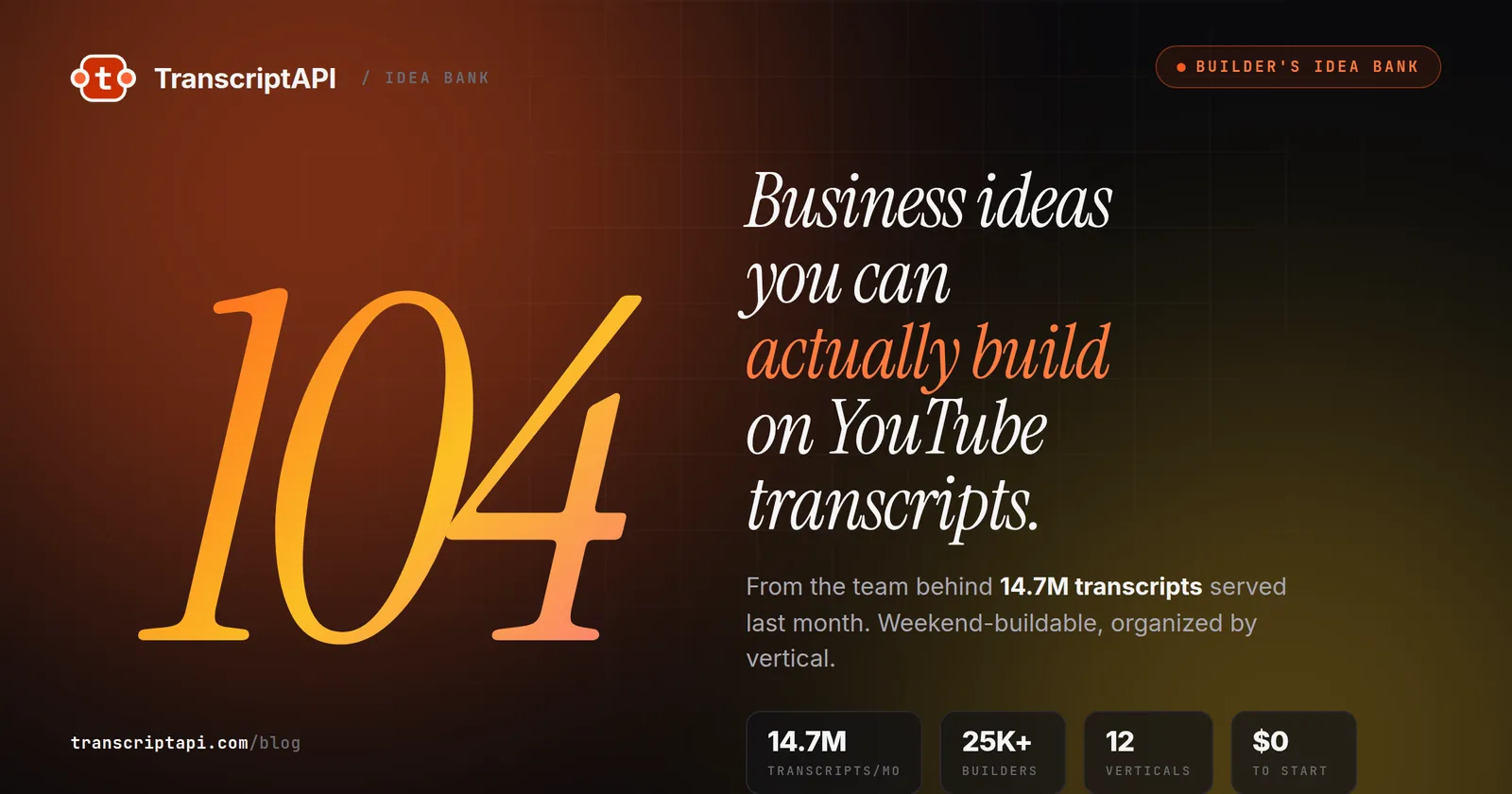
Business ideas you can actually build on YouTube transcripts.
A builder's idea bank from the team behind 14.7 million transcripts served last month. Skim it. Borrow what's useful. Build something this weekend.
Most weekend projects die because they need a moat that takes months to build. The 104 ideas in this list don't. They all sit on top of one underexploited resource: clean, structured transcripts from the largest content library on the internet.
TranscriptAPI is the API layer 25,000+ builders already use to pull those transcripts out of YouTube. Last month we served 14.7 million of them. We see what people are shipping with the data, and the surface area is much wider than what's been built so far.
This is the result: 104 business ideas, organized by vertical, with the obvious second tool you'd plug in. Then a no-fluff playbook on how to actually launch one, a marketing-channel matrix, and an FAQ for the questions every builder asks before they start.
Everything here is buildable in a weekend with Claude Code or CRHQ.ai, a free TranscriptAPI key, and a $9 domain.
The macro thesis, in four points
Before we get to the list, here's the framing. These four shifts are the reason transcript-based products are an unusually good place to spend a weekend right now.
Video is the largest content surface, and the least queryable
More than 500 hours of video are uploaded to YouTube every minute. Almost none of it is searchable beyond the title and description. Transcripts unlock the actual content (the words people said), and that's the layer most products are missing.
AI agents need real domain data, not synthetic
Foundation models are commoditized. The moat is what you train, fine-tune, or RAG against. Transcripts are some of the highest-quality, highest-volume domain data freely available, especially for niche verticals where licensed datasets don't exist.
Repurposing is the highest-leverage marketing activity
One long-form video → 10 tweets, 1 newsletter, 1 blog post, 5 shorts, a press kit. The pipeline is text in, text out. Whoever owns the cleanest input wins the funnel.
The bottleneck moved from creation to organization
There's already too much video content. The opportunity isn't producing more. It's organizing what exists. Search, summary, monitoring, structuring. That's where the next wave of AI products is being built.
How to use this list
Each idea has three things: the concept, why it works, and the obvious second tool you'd combine it with. Some ideas are obvious. Some are weird. A few are 'wait, that actually works?' Pick whatever clicks.
One sentence, plain English.
The market or behavior underneath.
The obvious second tool you'd plug in.
Four questions to ask before you build
Excitement is a terrible filter. Most weekend projects fail not because the execution was bad, but because the idea didn't pass these four tests. Run any candidate from the list below through them before you open your editor.
Is there an existing $X/mo product I'd unbundle from?
If yes, you know there's willingness to pay; you just need to undercut on focus or angle. If no, you're either pioneering (high risk, high reward) or solving a non-problem (the silent killer).
Does my output produce a public artifact?
Blog posts, summaries, quotes, shareable charts, embeddable widgets. Each output that escapes the app becomes a marketing asset and starts a flywheel. Without that, you're paying for every user.
Can a single user notice if the result is wrong?
High-stakes domains (medical, legal, financial) need accuracy work upfront and probably a human-review step. Low-stakes (entertainment, education, productivity) can ship rough and iterate. Match the bar to the stakes.
Could one person ship the v1 in a weekend?
If no, the scope is wrong. The point of validation is to find out if anyone cares before you spend three months building. If your v1 needs three months, you're optimizing the wrong end of the funnel.
Content & Media
The creator economy crossed $250B in 2025. The bottleneck is no longer creating content. It's organizing, repurposing, and surfacing what already exists. Transcripts are the layer that makes a YouTube catalog queryable, slice-able, and re-distributable.
Single-creator knowledge base
Fans want a 'ChatGPT trained on my favorite creator.' Search across 500+ hours beats scrubbing YouTube history.
Newsletter automation
'I want the news from my niche without doomscrolling YouTube.'
Video → blog post pipeline
Creators want SEO traffic; readers prefer text. Win-win when permissioned.
Podcast-as-text reader
Some people read 5× faster than they listen. Massive underserved segment.
Quote extractor
Creators need social-ready clips; agencies need quotes for press kits.
Highlight reel finder
Repurposing long-form into shorts is the #1 growth tactic right now.
Subtitle / SRT generator
Accessibility apps and dubbing pipelines need clean text.
Search across 'watch later'
Everyone's 'watch later' is a black hole. Fix it.
Best-of yearly recap generator
End-of-year content gets shared. Creators love it as a holiday post.
Auto-chapter generator
Creators get +30% retention with chapters; most don't bother adding them.
Press-kit generator
Founders, authors, and execs need this for every PR push.
Multilingual content adapter
YouTube's auto-translation is mediocre; clean transcript → translate is 10× better.
Marketing & SEO
Marketers spend more time researching than executing. Tools that compress 'what is the market saying about X?' from a week into 5 minutes have 10× the leverage of another scheduler or analytics dashboard.
Competitor video keyword mining
Easier than guessing keywords. Competitors literally tell you what works.
Reddit / Quora answer machine
Karma compounds. Smart automation here is rare.
Affiliate review aggregator
Affiliate sites are evergreen; transcripts make content scalable.
Brand-mention monitoring
Most brands have no idea who's organically talking about them.
Sentiment dashboard
Adjacent to PR; brands pay $10K/mo for similar tools.
Title/thumbnail A/B autopsy
YouTubers obsess over this. Sell to YouTubers.
Video → 20 tweets pipeline
Repurposing is the highest-leverage activity in marketing.
YouTube SEO advisor
Creators need this; SEO tools don't analyze content this deeply.
Influencer outreach personalizer
Reply rates 3-5× when you reference the actual content.
Ad-copy bank
Performance marketers spend weeks on copy research. Make it 5 minutes.
Education
Khan Academy proved video education works. The next 10× isn't more lectures. It's making the existing trillion hours of educational video queryable, summarizable, and convertible into structured study material.
Course-from-channel builder
Edtech with zero content creation cost.
Flashcard / Anki generator
Spaced-repetition is huge in med, law, language learning.
University lecture archive search
Schools have terabytes of content with zero discoverability.
Khan Academy → study notes
Students Google 'X notes' 1,000× a day.
Language learning corpora
Comprehensible-input apps (LingQ, Toucan) need this.
Code tutorial → runnable code
Developers waste hours pausing/transcribing.
Citation generator
Academia desperately needs this.
Tutoring chatbot
Parents will pay $20/mo for this.
Conference talk knowledge base
Tech conferences produce gold; nobody has time to watch all.
Domain mastery program
'Learn X by watching the right 50 videos.'
Business Intelligence
YouTube has more domain coverage than most paid news APIs, and most of it is free. Where Bloomberg charges $25K/seat for terminal access to a few markets, transcript-based BI tools can deliver 80% of the signal at 1% of the cost for niche industries.
Vertical news terminal
YouTube has more domain coverage than most paid news APIs.
Earnings-call CEO interview tracker
Hedge funds will pay 5 figures for this.
Conference talk auto-summarizer
Internal newsletter that never misses anything.
Investor day content extraction
Compliance, due diligence, plaintiff law.
Hiring research
Recruiters pay for this; HR vendors don't do it well.
Sales-call training mine
Sales enablement category is massive.
Competitor launch monitor
'Wake up when your competitor ships.'
Board / advisor briefings
Board prep is painful; this is the unlock.
AI / Data
Foundation models are commoditized. The differentiation is what you train, fine-tune, or RAG against. Niche transcript corpora (a single creator, a vertical, a language) are some of the highest-quality, highest-volume domain data available, and the moat compounds the more you collect.
LLM fine-tuning corpus
Domain-tuned models eat training data.
RAG knowledge base service
'Plug-and-play vertical RAG' is a gap.
Voice cloning training data
Authorized voice agents are launching now.
Sentiment-at-scale
Trend research, brand health, political analysis.
Topic modeling an industry
Strategy consultants will pay for this.
Semantic search engine
Better than YouTube search by 10×.
Synthetic dataset generator
The dataset bottleneck is real.
Creator persona twin
'Ask Andrew Huberman anything.' Massive consumer appetite.
Legal & Compliance
Public hearings, regulatory livestreams, and court proceedings are increasingly recorded, and almost none of it is searchable in any meaningful way. The civic-tech and legal-research opportunity is wide open, and the buyers (firms, journalists, compliance teams) have real budgets.
Public-hearings transcription
Local journalism is dying; civic-tech is rising.
Regulatory livestream monitoring
Hedge funds, lobbyists, compliance teams.
Court proceedings (where streamed)
The courts are increasingly recording everything.
Compliance training quiz extractor
Every Fortune 500 needs this.
Patent prior-art search
Patent firms charge $500/hr for this work.
Journalism & Research
Newsrooms shrunk 40% in a decade. Tools that 10× a single reporter (fact-check, archive, monitor) are now critical infrastructure. Same goes for OSINT investigators, academic researchers, and anyone who needs to sift large volumes of public-figure speech.
Press conference fact-checker
Newsrooms are starved for tools like this.
Politician statement tracker
Election cycles drive demand.
OSINT investigation aid
Investigative journalism, Bellingcat-style.
Misinformation detection
Platforms and academic groups want this.
Whistleblower archive
Academic, advocacy, museum use cases.
Activism documentation
Archive.org-style permanence.
Developer & SaaS Plugins
Distribution is the moat. A plugin meets users where they already are (Slack, VS Code, Notion, Shopify) and inherits the host's growth. These are the highest-leverage product types in 2026, especially for solo builders.
Slack bot
Internal teams will install this in 15 seconds.
Discord bot
Discord servers are huge; bots are sticky.
Browser extension
The lowest-friction entry point of all.
VS Code plugin
Developer tools have massive distribution leverage.
Obsidian / Notion plugin
Note-taking power users will pay $5/mo for this.
WordPress plugin
800M WordPress sites; SEO obsession.
Zapier / Make / n8n integration
iPaaS distribution is an underrated channel.
Shopify app
Conversion lift is real and measurable.
Email-to-summary
Zero friction, broad audience.
iOS Shortcut / Android Tasker
Power-user crowd; they evangelize.
Finance & Trading
Information asymmetry is shrinking; processing speed is the new edge. CFO interviews, Fed speeches, crypto streams, real-estate vlogs. The alpha is in turning unstructured speech into structured signal faster than the next desk.
CFO interview analyst
Buyside research desperately wants this.
Crypto signal extractor
Crypto traders pay for any edge.
Macro analyst feed
Macro funds will pay for this packaged.
Fund manager quote DB
LP relations, journalism, retail education.
Real-estate market monitor
Hyperlocal data is rare and valuable.
Pump-and-dump detector
Regulatory tech, retail safety, journalism.
Entertainment & Gaming
Reaction content, recap channels, and aggregators dominate Gen-Z attention. Transcripts are the structuring layer that lets you turn that fire-hose of opinion into a navigable archive, and there's a rabid audience willing to pay for the right one.
Movie / show recap generator
Reddit threads write themselves.
Speedrun strategy DB
Niche but rabid audience.
Esports commentary index
Sports analytics for esports is undeveloped.
Music cover analysis
Adjacent to music licensing.
Multilingual short-drama discovery
Massive growing segment globally.
Reaction video aggregator
Gen-Z content discovery.
Health & Wellness
Medical misinformation costs lives, and the verification tools are scarce. On the wellness side, fitness and mental-health are $50B+ markets crying out for personalization that builds on the creators users already trust. Move carefully here, but the demand is real.
Doctor-claim verifier
Misinformation is a massive problem; tools are scarce.
Patient education portal
Clinics pay for patient-engagement tools.
Workout / nutrition program builder
Fitness apps are a $20B market.
Mental health resource library
Demand outpaces supply for therapy tools.
Medical conference summarizer
Doctors pay $1K+ for conference-recap services.
Niche, Weird & 'Wait, That Works?'
Unproven, but the highest curiosity-to-cost ratio. A weekend project here might find a goldmine.
The biggest opportunities hide where competition is lowest. Most of the ideas below have zero direct competitors. They're unproven, but the curiosity-to-cost ratio is the highest on this list. A weekend project here might find a goldmine.
Sermon archive search
350K+ church channels on YouTube. Underserved.
Recipe extractor
Massive food-blog SEO opportunity.
DIY index
Practical, sticky homeowner tool.
Bedtime story generator
Voice + story API combo.
Travel itinerary builder
Maps + LLM + transcripts.
Pet-training Q&A bot
Niche + sticky + recurring.
Conspiracy taxonomy mapper
Academic / counter-disinfo angle.
ASMR script analyzer
Niche but huge, and underexplored.
Cooking-show ingredient tracker
Stats / fan engagement angle.
Boxing / MMA matchup predictor
Sports analytics adjacent.
Real-estate walkthrough DB
Real estate SaaS angle.
Therapy-prep tool
Personal, niche, sticky.
Standup-comedy joke bank
Comedy-writer aid; legal-grey but interesting.
Vintage product manuals
Niche, no competition.
University admissions advisor
Edtech adjacent; high willingness-to-pay.
Live event captioner
Live captions market is growing.
Music-class transcriber
Music education is a massive vertical.
Trial-prep video archive
Litigation tech opportunity.
Five patterns across all 104 ideas
Strip away the verticals and most of these ideas are variations on five underlying shapes. Recognize the pattern, and you can adapt any of them to a niche we didn't list. The strongest are worked up as real businesses, with who pays and what similar tools charge, on what to build with TranscriptAPI.
The Search Pattern
'Find me X across N transcripts.' Embeddings + vector DB + a clean UI. The simplest, highest-leverage pattern, and most of the productized versions are still mediocre.
The Monitor & Alert Pattern
'Tell me when X happens in this universe of channels.' Cron + filter + LLM scorer. Sticky, recurring revenue, and the buyer (PR teams, hedge funds, brands) has budget.
The Translator Pattern
One format in, another format out. Video → blog. Lecture → flashcards. Episode → recap. The win is automating something a human currently does manually for hours.
The Personalizer Pattern
Use someone's actual public content to tailor an outreach, brief, or summary. Reply rates and conversion lift are real and measurable.
The Knowledge Pattern
Q&A / chatbot / RAG against a creator's catalog or vertical archive. The 'ChatGPT trained on my favorite expert' pattern. Massive consumer appetite, especially in education and health.
You picked an idea. Now what?
The no-fluff version. 11 steps. Skip whatever you already know.
Pick something you actually know
Don't pick the idea that sounds most exciting. Pick the one where you have domain expertise or genuine personal interest. A 'smarter person from outside' loses to you on craft.
Build a prototype this week
Pull 50 transcripts in your niche. Use Claude Code or CRHQ.ai to scaffold. Keep the UI ugly. One feature only. If it takes more than a weekend, you're scope-creeping.
Slap a landing page on it
$9 domain. One screenshot, one paragraph, an email field. Framer, Webflow, Carrd, or plain HTML all work. Don't sweat copy or brand.
Get your first 100 users
Reddit, HN (Tuesday morning UTC), Indie Hackers, niche Discords, AI directories. Don't cold-DM strangers. Don't buy ads yet.
Don't price it yet. Listen.
First 4 to 8 weeks: free. Talk to 10 users on 15-min calls. Note their words. That's your marketing copy.
Then test pricing
Three price points at once: $5 / $19 / $49 are good defaults. Annual at 20% off improves cash flow.
Iterate weekly, in public
Ship something every week: feature, fix, screenshot, roadmap. Document it publicly.
Live where your audience lives
Reddit? LinkedIn? Discord? Spend 2 weeks observing before you spend on any channel.
Pick the right channels
SEO is patient. Reddit/HN need a real story. Paid ads need LTV > CAC with margin.
Build your flywheel
Public artifacts, embeds, referrals, build-in-public. Pick the one that's working and double down.
Be patient where it compounds, fast where it doesn't
SEO and trust take months. Shipping a feature, fixing a bug: those are days. Confusing the two is the most common founder mistake.
Channels: when each one works
You don't need them all. You need the one that fits your stage. Each card below: the channel, when it works, when it doesn't.
You need to know your customer's lifetime value before you spend a dollar on ads. If you don't know it yet, you're not ready for paid.
Questions builders ask before they start
Eight things that come up in almost every conversation we have with someone shipping a transcript-based product. Read them now, save yourself a week later.
Is it legal to use YouTube transcripts in my product?
YouTube auto-captions are generated content under the platform's ToS. The safe pattern: scope your product to fair-use cases (search, summarization, education, accessibility) with proper attribution to the source video. For commercial products built on a specific creator's catalog, get explicit permission. For everything else: don't try to be a YouTube replacement, and don't strip attribution. We're not lawyers, so get one before you scale.
How much do transcripts cost at scale?
TranscriptAPI's free tier (100 credits) covers most validation. From there, pricing is usage-based and runs roughly $1-3 per 1,000 transcripts depending on plan. Most weekend projects don't approach paid tiers until they cross ~1,000 active users. The cost is rarely the constraint at this stage. Distribution is.
What's the typical tech stack for these projects?
Frontend: Next.js, Astro, or plain Vite + React. Backend: Node or Python (FastAPI). Vector DB: Pinecone, Qdrant, or pgvector. LLM: Claude (better for structure) or GPT-4o (better for breadth). Hosting: Vercel + Supabase covers 80% of these. Don't over-engineer. Your v1 doesn't need Kubernetes.
How do I get my first paying customer?
Pick a niche where you already have credibility, post your demo with a personal story (not a sales pitch), and offer the first 10 customers a steep discount in exchange for a written testimonial. Cold-emailing strangers does not work. Showing up authentically in a community where your future user already hangs out does.
When should I worry about scale?
When you're spending more time on infra than features, you've hit the constraint. For most transcript-based products, that's around 5K-10K active users, at which point you're probably ready to charge for it anyway.
What if my idea overlaps with #X on the list?
Two builders rarely build the same product. Differentiation comes from your niche choice, your distribution channels, and your taste in what to ship, not from the underlying idea. The idea is 5% of the work; the other 95% is execution. Pick the one you'd use yourself, weekly.
I'm not a strong engineer. Can I still build one of these?
Yes. Claude Code, CRHQ.ai, Cursor, and v0 have collapsed the gap between 'I have an idea' and 'I have a working prototype' to a weekend, even for non-engineers. The real bottleneck for most people isn't coding ability. It's deciding to start.
How do I know if an idea has real demand vs. me just liking it?
Run the cheapest possible test before you build. A 1-page landing page describing the product with an email signup, posted in 3-5 places where your target user hangs out, will tell you in 48 hours whether anyone cares. If 50 people sign up, you have something. If 5 do, you don't yet.
If you found this useful, the easiest way to thank us is to send it to one other builder who'd like it.
Frequently Asked Questions
- What kinds of business ideas are in the list, and how are they structured?
- 104 ideas across 12 verticals — categories like education tools, content repurposing, developer tools, and research products. Each pairs TranscriptAPI with the obvious second tool to plug in alongside it, such as an LLM for summarization or a search index for retrieval, and each is framed as buildable in a weekend using Claude Code or CRHQ.ai, a free TranscriptAPI key, and a $9 domain. The list is meant to be skimmed: borrow what's useful and build something this weekend.
- What's the "why now" thesis for building transcript-based products?
- Four macro shifts. Video is now the dominant format for expert knowledge, holding content that exists nowhere in writing. AI models can process long-form text at scale, turning raw transcripts into structured products. YouTube transcript APIs have dropped the extraction barrier to a single call and $0 to start. And niche SaaS can now reach paying customers without big marketing budgets or large teams. Together they open an unusually good window for weekend-buildable transcript products.
- What does the 11-step launch playbook cover?
- A concrete path from idea to first paying customer: pick one vertical, validate demand within 48 hours before building anything, build an MVP with AI coding tools, set pricing, and identify the right distribution channels for that vertical. It comes with a marketing-channel matrix that maps each vertical to the channels most likely to reach its target buyers.