

Building Production Agents with TranscriptAPI MCP: 5 Patterns That Actually Work
You wired up the TranscriptAPI MCP server in Claude or Cursor, asked the agent to summarize a video, and felt that small rush. It worked. Then you tried to summarize 200 videos in one conversation, and the wheels came off. This article is for that moment. Below are five production patterns for building real agents on top of TranscriptAPI MCP, the failure modes that show up at scale, and the fixes that keep things running. Code is Python. Opinions are direct.
MCP is great for demos. Here's what changes when you ship it.
MCP shines for one-shot agent calls. A user asks a question, the agent grabs one transcript, the answer comes back. Clean.
Production is different. Production means hundreds of videos per run, retries, idempotency, billing alerts, and a context window that does not turn into soup at video #47.
Here is the honest take: the transcriptapi mcp server is the right tool for interactive agents and ad-hoc research. It is the wrong tool for batch jobs. The five patterns below tell you which is which.
Pattern 1: the summarizer pipeline
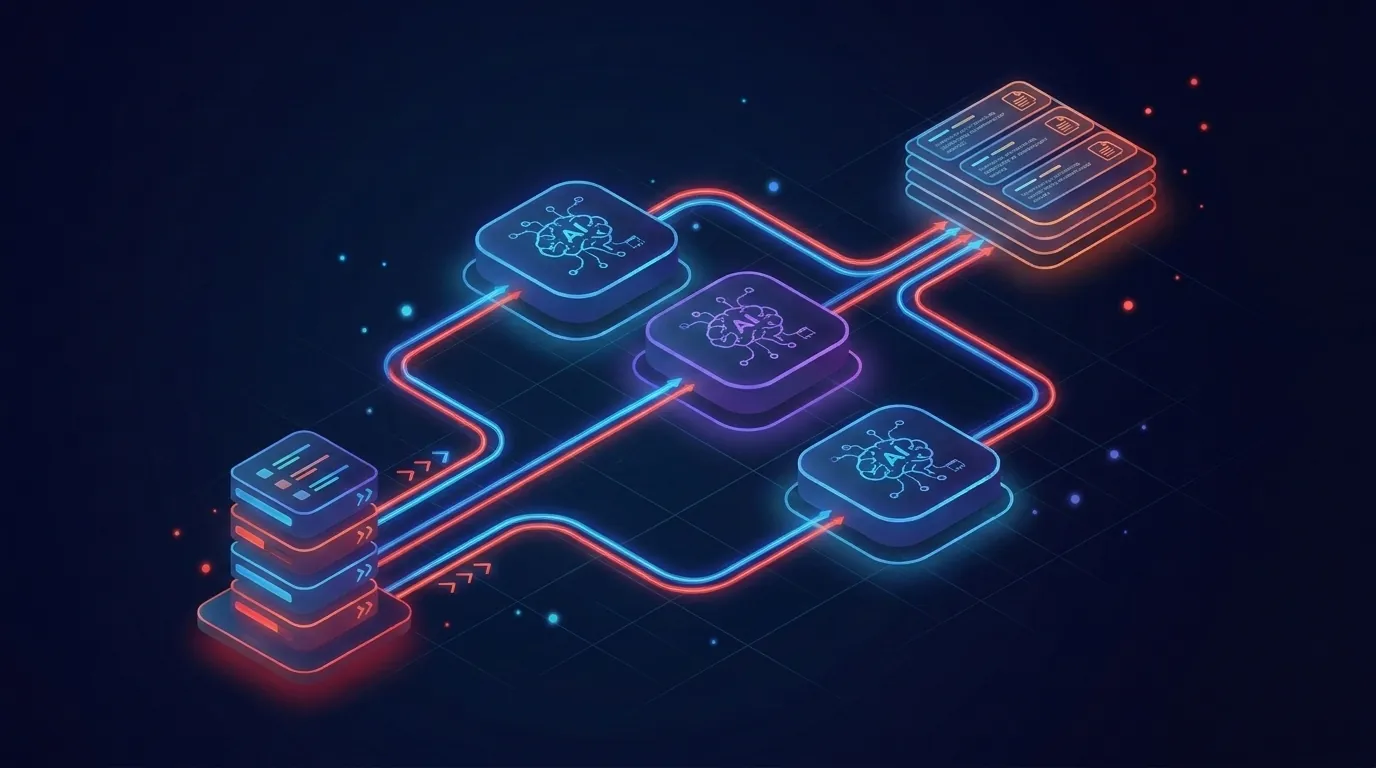
You want to summarize every new video from a list of channels each morning and post the summaries to Slack or Notion. Sounds simple. It is not.
Why direct MCP fails at >50 videos
When the agent calls the MCP tool 50 times in one conversation, three things break.
- The full transcript text returns into the model's context window. Fifty 10-minute videos is roughly 250K tokens of input. You will hit the cap.
- The agent loop has no real retry policy. One 429 from upstream and the whole run stalls until the model decides what to do.
- You pay model tokens for transcript bytes the model does not need to "see," only summarize.
I've watched this exact sequence play out on a content-ops team. They moved from "wow, this works" to "why is our Anthropic bill 8x" in a week.
Queue + worker pattern
The fix is to take the transcript fetch out of the agent loop. The agent decides what to summarize. A worker fetches and stores. A second pass summarizes from the store.
# producer (runs once a day)
import httpx, redis
r = redis.Redis()
HEADERS = {"Authorization": f"Bearer {API_KEY}"}

for channel in CHANNELS:
    latest = httpx.get(
        "https://transcriptapi.com/api/v2/youtube/channel/latest",
        params={"channel": channel},
        headers=HEADERS,
    ).json()
    for v in latest["results"]:
        # idempotency: video_id is the key
        r.sadd("queue:transcripts", v["videoId"])
The worker pulls IDs, calls /youtube/transcript with one credit each, writes to Postgres, then a second job hands clean text to the LLM in batches. The MCP server is now reserved for the human asking, "hey, what did Lex Fridman cover this week?" That is what it is good at.
Pattern 2: the research assistant
A user asks the agent: "compare how Andrej Karpathy, Yannic Kilcher, and Two Minute Papers covered Mixture-of-Experts over the last year." This is the sweet spot for youtube transcript mcp workflows. It is also where context blows up if you are not careful.
Multi-channel context window strategy
Do not load full transcripts. Load summaries.
The pattern that works: a one-time backfill stores transcripts plus a 200-word summary per video in your own database. The agent's MCP tool surface is two tools, not one. You expose search_my_summaries(query) and fetch_full_transcript(video_id). The agent searches summaries first, then pulls full text only for the 3-5 videos it actually needs to read.
This keeps a 60-video research question inside a 30K-token working context. Without it you are at 600K and falling over.
Caching transcripts to your own store
TranscriptAPI transcripts do not change. Once a video is captioned, the text is stable. Cache forever.
A simple Postgres table covers it.
create table transcripts (
  video_id    text primary key,
  fetched_at  timestamptz not null default now(),
  text        text not null,
  summary     text,
  metadata    jsonb
);
You are paying one credit per video, ever. Not one credit per question. At $1.50 per 1K credits on the annual plan, a 10K-video research corpus costs $15 to build and $0 to query. Make sense?
Pattern 3: the search-over-channel agent

Use case: "find every clip in MKBHD's catalog where he mentions Vision Pro." The MCP tool channel/search is great for one or two queries. For deep semantic search across thousands of videos it is the wrong layer.
Embedding strategy
Run this offline, once.
- Pull the channel's full video list with
/youtube/channel/videos(paginated, 1 credit per page of 30). - Fetch each transcript and chunk it into 500-token segments with 50-token overlap.
- Embed each chunk with your embedding model of choice.
- Store in pgvector or any vector DB you already run.
Now your agent's search tool is a vector lookup, not an MCP call. Sub-50ms latency, no per-query API cost, and the results carry timestamps so the agent can return clickable links.
When to bypass MCP and call the API directly
This is the most underrated decision in production agent design.
MCP is a protocol for an LLM to call tools. If the work has no LLM in the loop, you are paying a protocol tax for nothing.
A nightly worker that ingests new videos from 200 channels should call https://transcriptapi.com/api/v2/youtube/channel/latest directly with httpx. No agent. No tool schema. No model tokens. Just a REST request, a Postgres insert, and a log line.
Save the MCP path for the moments a human is asking the agent something. That is the rule. Free for prototypes. Paid for production. Direct REST for batch.
Pattern 4: the monitoring + alerting agent
Build an agent that watches 50 competitor channels and pings you when one of them publishes a video about a topic you care about. Say, "AI agents" or "your product name."
Hybrid free RSS + paid transcript
This is where the youtube mcp server cost story gets fun. The channel/latest endpoint is free. RSS-based, returns the latest 15 uploads per channel, costs zero credits.
So the polling layer is free. You only spend credits when a new video shows up and you actually want to read it.
def check_channels(channels):
    new_videos = []
    for ch in channels:
        latest = httpx.get(
            "https://transcriptapi.com/api/v2/youtube/channel/latest",
            params={"channel": ch}, headers=HEADERS,
        ).json()
        for v in latest["results"]:
            if v["videoId"] not in seen:  # idempotency check
                new_videos.append(v)
                seen.add(v["videoId"])
    return new_videos  # zero credits spent so far
Then a second pass: for each new video, fetch the transcript (1 credit), pass it to the model with the prompt "does this discuss X? If yes, give me a 100-word summary and a quote." Skip the rest.
A 50-channel monitor polling four times an hour costs zero credits to watch and roughly 1 credit per relevant new video. Your monthly bill scales with signal, not noise. That is a healthy production agent.
Pattern 5: the video-to-code agent
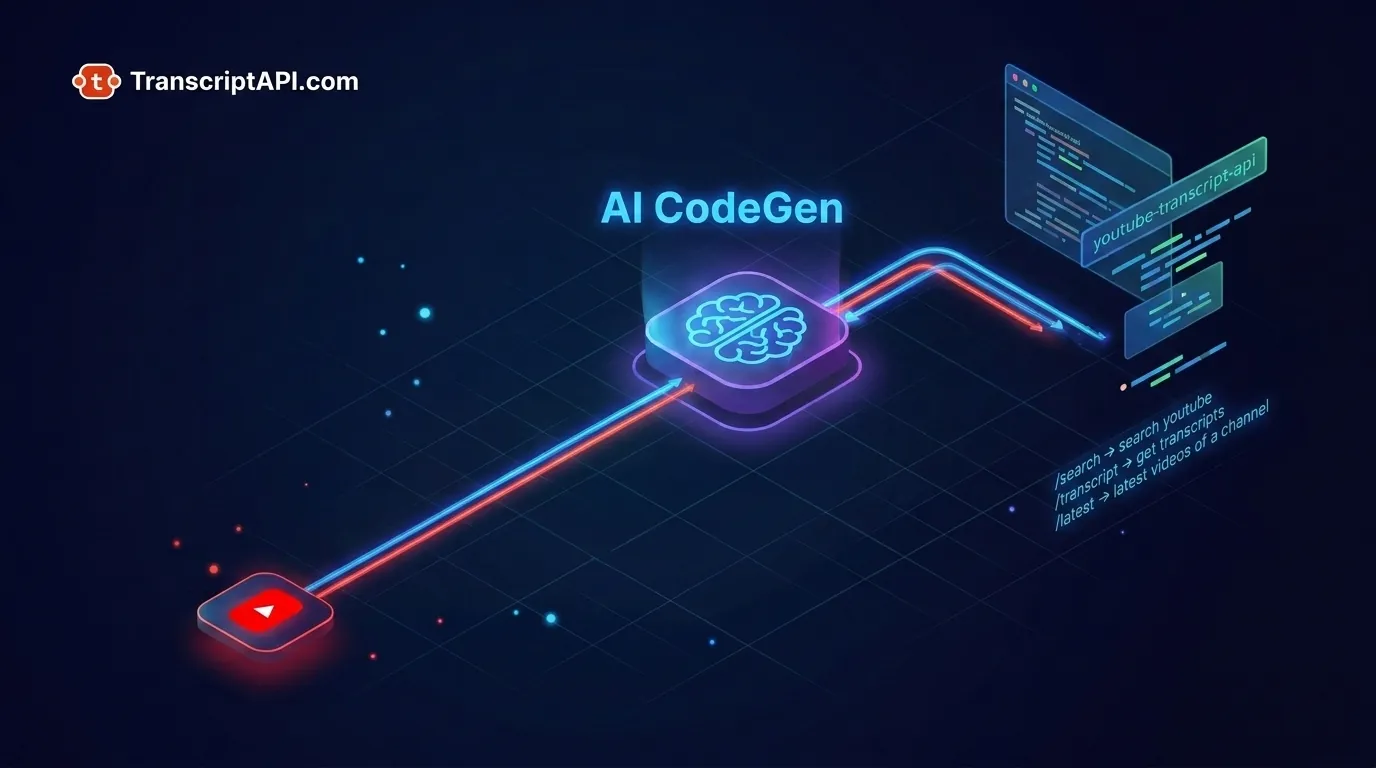
The use case I keep hearing: a developer pastes a YouTube URL of a tutorial, and the agent returns a working code file. Tests pass. Imports resolve. No copy-paste.
This sounds like magic. It is mostly prompt engineering plus a verification loop.
Prompt engineering for code extraction
Raw transcripts are messy. Speakers say "import numpy as np" and the captions write "import numpy as MP." Code blocks are spoken, not typed. The agent has to reconstruct.
Three things that help:
- Always pass
include_timestamp=trueso the model can ground each code block in a moment of the video. - Ask the model to output a structured plan first (file names, dependencies, expected behavior) before writing code.
- Then ask it to write the code, citing transcript timestamps for each block. Citations force the model to stay close to the source.
Sample system prompt fragment:
You are reconstructing code from a video transcript.
1. Read the full transcript. List every file the speaker creates.
2. For each file, list the dependencies and the function signatures.
3. Write each file. After every code block, cite the transcript timestamp it came from.
Verification loop
Now the production part. Take the generated code and actually run it.
The agent writes the file, executes it in a sandbox, captures the error, and re-prompts itself with the error and the relevant transcript chunk. Loop until tests pass or you hit a retry cap (3 is sane).
This is where claude mcp youtube setups beat hand-rolled scripts. The agent already has a code-execution tool. Wire the transcript MCP tool next to it and the loop happens naturally inside one conversation. For one video, MCP wins. For 500 videos in a batch, see Pattern 1.
Cross-cutting: error handling, observability, cost control
The patterns above share four production concerns. Get these right once.
Idempotency keys are the video ID
Every TranscriptAPI request is keyed on a YouTube video ID. Use it as your idempotency key everywhere: queue de-duplication, cache lookup, log correlation. It is already unique. Do not invent a new ID.
Cache transcripts forever
Said this in Pattern 2. Saying it again because it is the single biggest cost lever. Transcripts are immutable. Cache hit rate on a mature system should be above 95%. If you are below that, you are paying credits twice for the same bytes.
Log every API call with cost
One log line per call, structured.
logger.info("transcriptapi_call", extra={
    "endpoint": "youtube/transcript",
    "video_id": vid,
    "credits": 1 if response.ok else 0,
    "latency_ms": elapsed,
    "status": response.status_code,
})
Failed requests are never charged, so log credits=0 on errors. Aggregate daily. You will see the leak inside a week.
Top-up alerts before you run dry
Set a Slack webhook that fires when daily spend exceeds your normal baseline by 2x. Set a second one that fires when remaining credits drop below a 3-day buffer. This costs you 30 minutes to wire up and saves the 2 a.m. "the agent stopped working" page.
How to put this into action
- Pick the one pattern above that matches your real use case. Do not build all five. Start with the closest fit.
- Get a TranscriptAPI key and burn the 100 free credits on a working prototype against your own data, not example videos.
- Stand up a Postgres or SQLite table with the schema from Pattern 2. Cache every transcript you ever fetch. Do this on day one.
- Decide where MCP belongs and where direct REST belongs. Interactive = MCP. Batch = REST. Write that rule into your code review checklist.
- Add the four cross-cutting pieces — idempotency, cache, structured logs, top-up alerts — before you scale past 1,000 videos.
- Move to the annual plan once you are sure of usage. Top-ups drop from $2.50 to $1.50 per 1K credits, a 40% cut.
The bottom line
MCP production patterns for transcriptapi mcp agents come down to one principle: keep the model out of the bytes. Let the agent decide what to read. Let workers fetch and cache. Use the free channel/latest endpoint as your polling layer. Bypass MCP when no human is asking. Do these four things and your agent stops feeling like a demo. Which of the five patterns is closest to what you are building right now?
Frequently Asked Questions
- Why does using MCP directly to process 50+ videos in one agent conversation fail?
- Three things break at once. The full transcript text floods the model's context window — 50 ten-minute videos is roughly 250K tokens of input, which blows past the cap. The agent loop has no real retry policy, so a single 429 from upstream stalls the whole run. And you pay model tokens for transcript text the model only needs to summarize. One content-ops team saw its Anthropic bill jump 8x in a week from exactly this pattern.
- What is the queue-and-worker pattern, and when should I use it?
- It separates the agent's decisions from the data fetching. The agent, via MCP, decides what to summarize and drops video IDs into a queue (for example Redis). A separate worker pulls transcripts from TranscriptAPI, stores them in a database like Postgres, and a later pass sends the clean text to the LLM in batches. The MCP server stays reserved for interactive human requests. Use this for any batch job over roughly 10 videos.
- How do I prevent context-window overflow when researching across many YouTube channels?
- Use a context-budget strategy: load transcript summaries first instead of full text, fetch a full transcript only when its summary shows the video is genuinely relevant, and run a token counter that stops loading more once you near the model's context limit. For multi-channel research this lets the agent scan dozens of videos while fully loading only the three to five that actually answer the question.